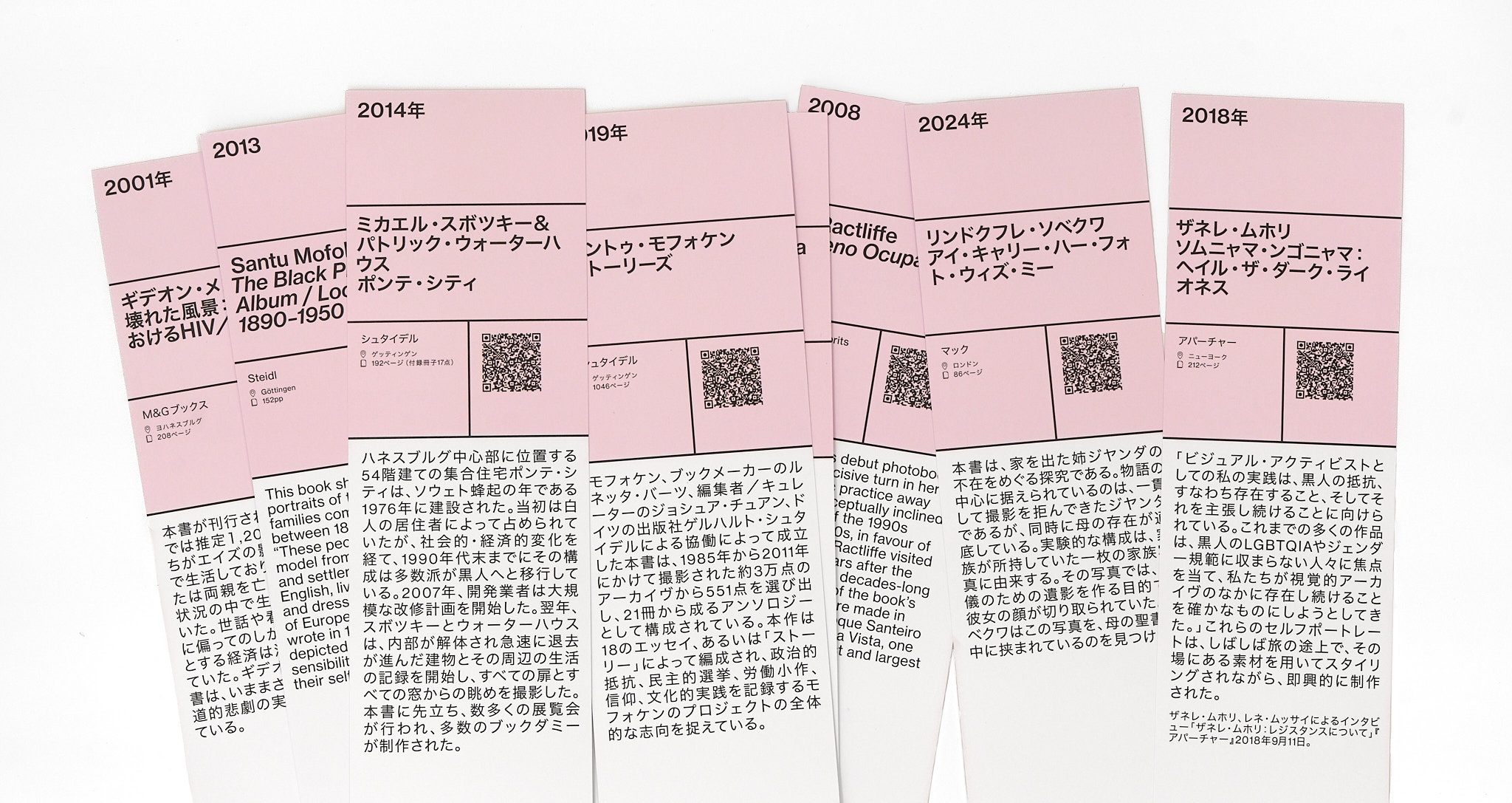
The early years of South Africa’s democracy see a meagre output of photobooks, followed by a remarkable flourishing. The increasing use of photography by artists, coupled with the emergence of a vibrant international art market, sponsors a proliferation of photobook publishing. It also muddies the fuzzy boundaries distinguishing the artists’ book, photobook and promotional catalogue. The internet, now a dominant presence in daily life, also qualifies the book’s apex position as primary store of distributed knowledge. Vivid experiments and bland rehearsals typify the books of this period. Colonial and apartheid history is a site of frequent excavation. Identity remains an abiding concern of photobook practitioners.
• Keywords: Internet, freedom, art, new/post/anti-documentary, studio, seriality, memory, identity
2000年頃-2025年
南アフリカの民主化初期にはフォトブックの刊行は限られていたが、その後、顕著な広がりを見せる。アーティストによる写真表現の拡張と、国際的なアート市場の活性化が相まって、フォトブック出版の増加を後押しした。同時に、アーティストブック、フォトブック、プロモーショナル・カタログを隔てる曖昧な境界は、さらに揺らいでいく。
日常生活において大きな存在感を持つようになったインターネットは、分散された知の主要な蓄積媒体としての書物の位置づけを相対化している。この時期の書籍は、鮮烈な実験と反復的な試みのあいだを往還している。植民地主義およびアパルトヘイトの歴史は繰り返し掘り起こされ、アイデンティティはフォトブックの実践者にとって持続的な関心であり続けている。
キーワード:インターネット、自由、アート、ニュー/ポスト/アンチ・ドキュメンタリー、スタジオ、連続性、記憶、アイデンティティ