Adel Abdessemed
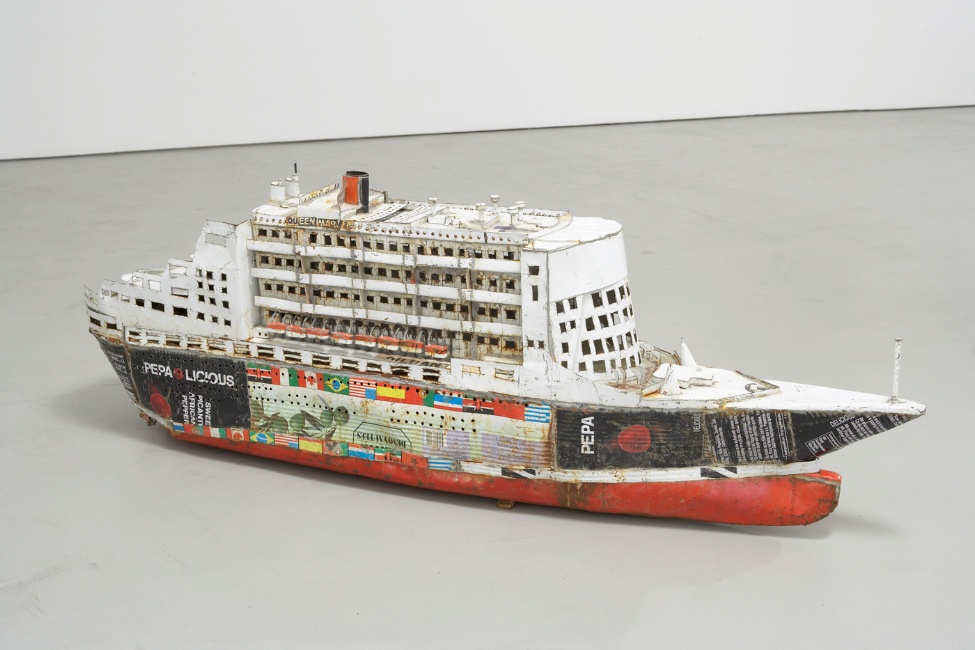
Queen Mary II (l’enfant) is one of a suite of model boats made in the image of the famous British ocean liner, of which the first, Queen Mary II (la mère), carries in its subtitle both the French for ‘the mother’ and its homonym la mer, ‘the sea’. The subsequent four works – l’enfant, la fille, l’aîné, and le fils, ‘the child’, ‘the daughter’, ‘the eldest’ and ‘the son’ – are smaller in scale than their matriarchal counterpart, but composed of the same salvaged parts. Printed tin, used to package all manner of goods from foodstuffs to chemicals, is a familiar resource in many industrial nations, where such pliable waste metal is remade as tools and toys. It is similarly a familiar material in Adel Abdessemed’s practice, the discard of mass-produced tinned products weighted with a history of resource extraction, first under the banner of imperialism and later globalisation. Refigured in scrap, the flagship vessel is rendered an unseaworthy skip, “rich and poor at once” as Abdessemed has said, a luxury cruise ship reminiscent of a Mediterranean migrant tug. The confusion of associations – of nostalgia for bygone transatlantic travel and the desperation of those fleeing persecution and poverty, a royal family and the family left behind – lends the artist’s boats their ambivalent buoyancy.
b.1971, Constantine
“Up and at ‘em – that’s how you attack an unopened fruit…” Adel Abdessemed practices art as the undertaking of radical and truthful acts. This commitment involves risk. Abdessemed has stoked public ire as well as invited institutional banning. The artist’s exhibition was closed early in San Francisco (2008), a work withdrawn in Lyon (2018). In October 2017, the Guggenheim in New York pulled three of his works from the exhibition Art and China after 1989: Theatre of the World before its opening. Few artists risk separation from both pillars, audience and patron, in the performance of their duty to hold a mirror to society. Abdessemed refuses to look away, however grotesque the reflection. He went into exile from Algeria in 1994 during the Civil War after the progressive director of his alma mater was murdered by militants on the art school’s steps. Relocating from Lyon to New York to Paris, Abdessemed became an international wanderer, curated prolifically onto the Biennale circuit across multiple iterations in São Paulo, Havana, Venice, Lyon and Gwangju, among others. Often, he recycled materials from the immediate vicinity in which he found himself. Aluminium cans were used to make works like the boat Queen Mary II (2007) and his Mappemonde series (2010–2014), the latter which removes the differences indicated by national flags and flattens hierarchies between territories by presenting all in the same colours. Abdessemed believes the artist acts as a witness first, without comment, leading beyond the miasma of fear created by media, politicians, working as much with the intimate as with the very large. Nothing less is possible when living in what he terms the age of un grand cri, “the great scream”.