Vivienne Koorland
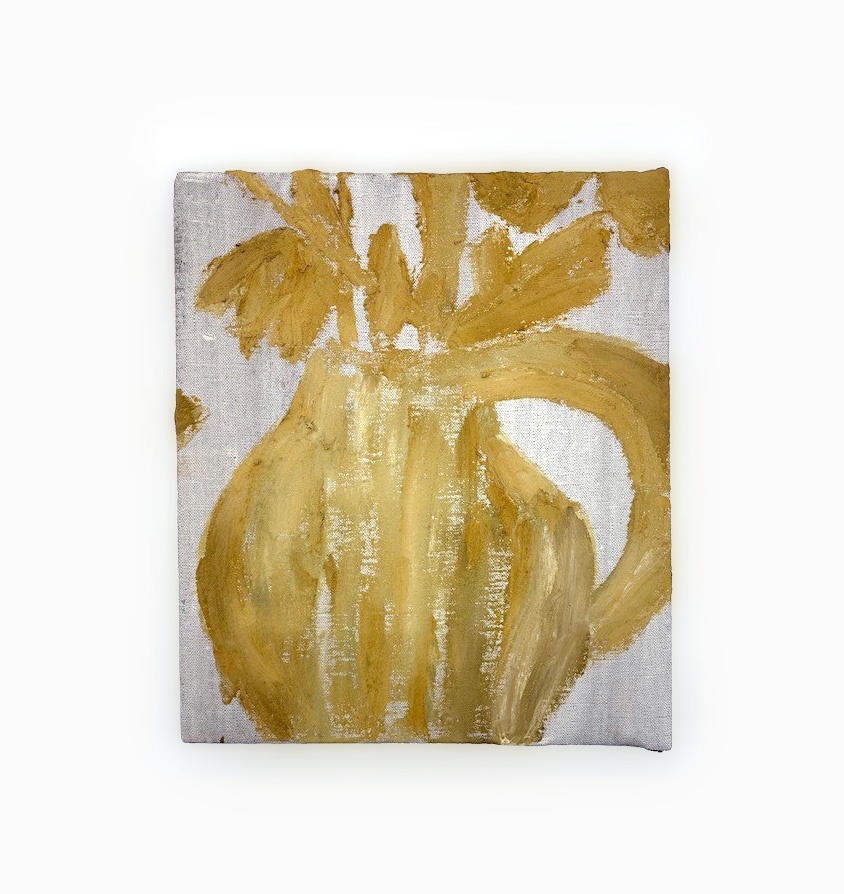
Marie is unusual in its material simplicity and modest size from an artist given to densely detailed mixed-media works of often monumental scale. In apparent counterpoint with what one might call her history paintings, this still life of a jug of flowers – abridged in detail and framing – has the reduced silhouette of a sign rather than an observation study. Its signification, however, remains unclear. An earlier work of the same title made in 1995 was included in Vivienne Koorland’s exhibition at the Irma Stern Museum in Cape Town in 1998; a later version, which echoes in name and subject the same object, is dated 2008. Perhaps there are others, too. The arrangement of flowers and the invocation of a woman’s name appear a productive pairing in the artist’s preoccupations, however veiled in meaning to the viewer.
b.1957, Cape Town
While registering her own inheritance, Vivienne Koorland’s tactile reflections on journeying and displacement extend beyond the autobiographical to address global histories of dispossession. Born in 1950s apartheid South Africa to a Polish Holocaust survivor, whose parents were killed in the Warsaw ghetto, and a South African father of Afrikaans descent, the artist has long been preoccupied with a sense of provisional belonging and unsettled national identity. From the colonial subjugation of Africa and the mechanised murder of Fascist Europe, to more recent cataclysmic events the world over, her paintings are weighted with accumulated references. “The less rooted I feel in a place,” Koorland says, “the more I need the paintings to be heavy, both in content and as material objects.” Composed of strata of applied pigments and oil paint on rough burlap backing, into which she works paper ephemera and transcribes gestures, drawings and inscriptions lifted from wide-ranging archival references, her works appear as cartographic palimpsests, an accrual and confusion of maps and keys. Accretion and excavation introduce a central tension in her practice. “If anything is worth looking at or doing, it can’t all be on the surface. I need to peel it away.” The substrate of these works is thick with contested meaning; no single narrative is conveyed, no one retelling foregrounded. Instead, each appears an entanglement of historical flotsam drawn into unanticipated proximity.