Lisa Yuskavage
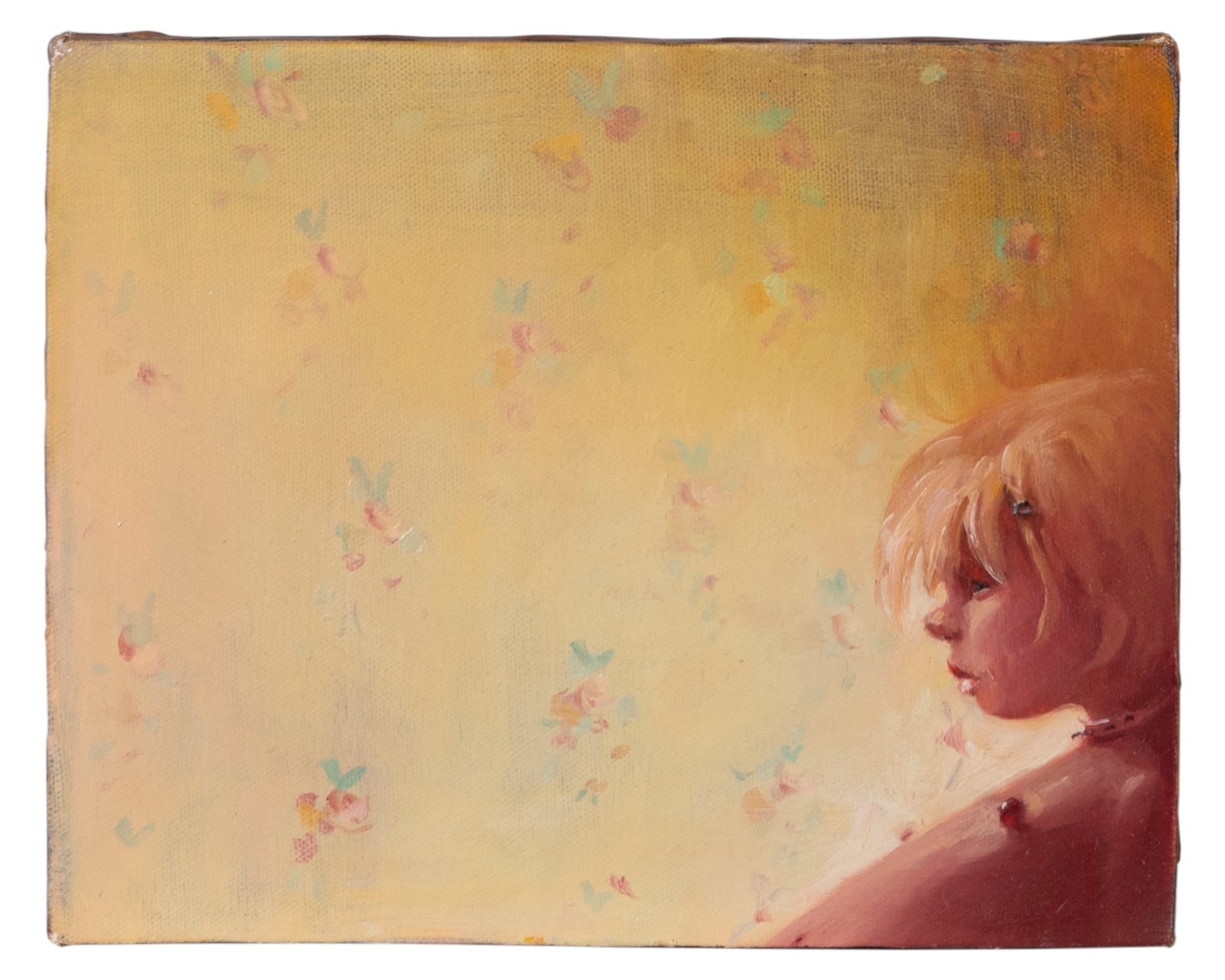
The threat of violence and intimations of sexual exploitation hum beneath many of Lisa Yuskavage’s incandescent scenes, particularly those that feature childlike characters. In Little Laura, a small-scale study reprised the following year in the larger Big Little Laura (1998), a girl is pictured against an embellished wall, the diagonal of her undefined torso punctuated by an overstated nipple, which appears a polished grape or gemstone balanced on her chest. Precocious in her choker necklace, vulnerable in her naivety – to the artist, early teenagerhood is a confusion of little-girl faces and grown-up features and feelings. Her works at the time, as she recalls, were similarly suspended between two states: “My paintings were like pubescent girls. They wanted to hide, but they couldn’t hide… I wanted to tell the truth about something gnarly. I had never seen a painting that included a kind of vulgar experience of being a female.” A golden light floods the composition, lending its discomfiting subject a benign warmth.
b.1962, Philadelphia; lives in New York City
“When I think about what American figurative painting looked like at a certain point…it all seemed to have been anorexic. I didn’t want it to be like some dried-up thing, I thought that it could be made into something very juicy.” Since the early 1990s, Lisa Yuskavage has produced saturated scenes that quote both soft-core porn and pin-ups – and art historical artifice. Her discordant coupling of high and contemporary déclassé culture lends these compositions what art critic Peter Schjeldahl called their “wacked-out emotional tone.” Another critic, describing Yuskavage’s luminously synthetic palette, noted her “shrill golds, panting purples, hot pinks.” Panting is particularly apt. Her stylised female characters, pictured in degrees of undress, are given to be seen as objects of sexual desire, with balloon-like bottoms, perky nipples, and upturned breasts and noses. That the artist was raised in a Catholic community and had brief ambitions to become a nun makes her paintings all the more startling for their subject:
Why do I insist on allowing elements of pornography into my work? I think it’s because I’m aware that it’s the benign presence of the devil. Whether I believe in the devil is really not the point. I’m talking about the idea. I think this idea of the sacred and the profane has always existed in art. It’s a constant theme for me: the struggle between the desire to be right and the desire to be wrong. I think it’s all just wanting to be true. And what is true and correct and right in art is often wrong in the world.
Yuskavage insists, however, that her paintings are primarily about painting rather than provocation. Any confrontational or crass quality, she suggests, is perhaps less a matter of content than of colour.