Theda Sandiford
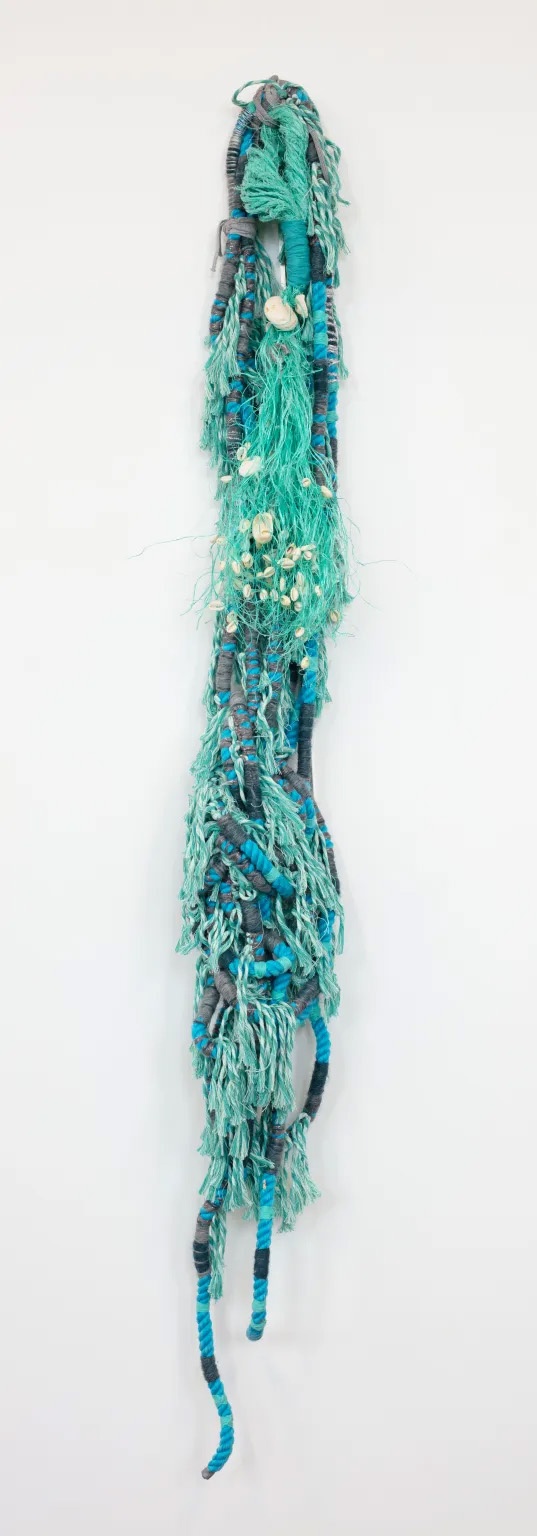
Weaving together personal and communal accounts, Theda Sandiford’s tactile series of seemingly abstract works, ‘I Am My Hair’ – from which Liquid Ice is taken – confronts racially charged preoccupations with black women’s hair. “You touch my hair without permission. Why? To see what makes us different? I ask – what makes us the same?” the artist writes in an accompanying text. Each of the tapestries (a designation loosely applied to these mixed-media arrangements) is made in collaboration with others, the resulting compositions the culmination of collective effort. “I invite the community to wrap, knot, and weave thousands of yards of yarn, recycled sari thread, plastic cord, ribbon, sequins, and pom-poms into 100 feet of cotton rope,” Sandiford continues. “Thousands of participants have left their imprint, bonding over stories of grey strands, locs, wigs, and braids. Through our differences, we found our common ground – hair.”
b.1970, New York
In Theda Sandiford’s practice, the phrase ‘social fabric’ finds a material form in her fibre-based installations composed of community-sourced and salvaged objects. Knotting, coiling, and braiding disparate parts into intricately detailed arrangements, she asks after the shared histories and contemporary realities recalled by such unlike things as hurricane debris, plant matter, beads and bottle caps, fabric off-cuts, and discarded shopping trolleys, among others. “I am drawn to the weight of objects that have passed through many hands, the textures that whisper of labour, care, and survival,” Sandiford says. “By repurposing and recontextualising them, I give voice to experiences that might otherwise be ignored… embedding within my pieces the stories and struggles that are often concealed beneath the surface.” Her collaborative works and participatory engagements extend reflections on racial, gender, and class bias and express the artist’s continued commitment to both social justice and sustainability. Of her practice, she says:
In an era when dominant narratives often seek to erase or rewrite history, my art insists on remembrance, on presence, on truth. It is both shield and mirror – offering protection and clarity in a world that often seeks to obscure. My work does not provide easy answers, but rather compels us to sit with the questions, to acknowledge the weight of silence, and to recognise the power of being seen.