Adolph Gottlieb
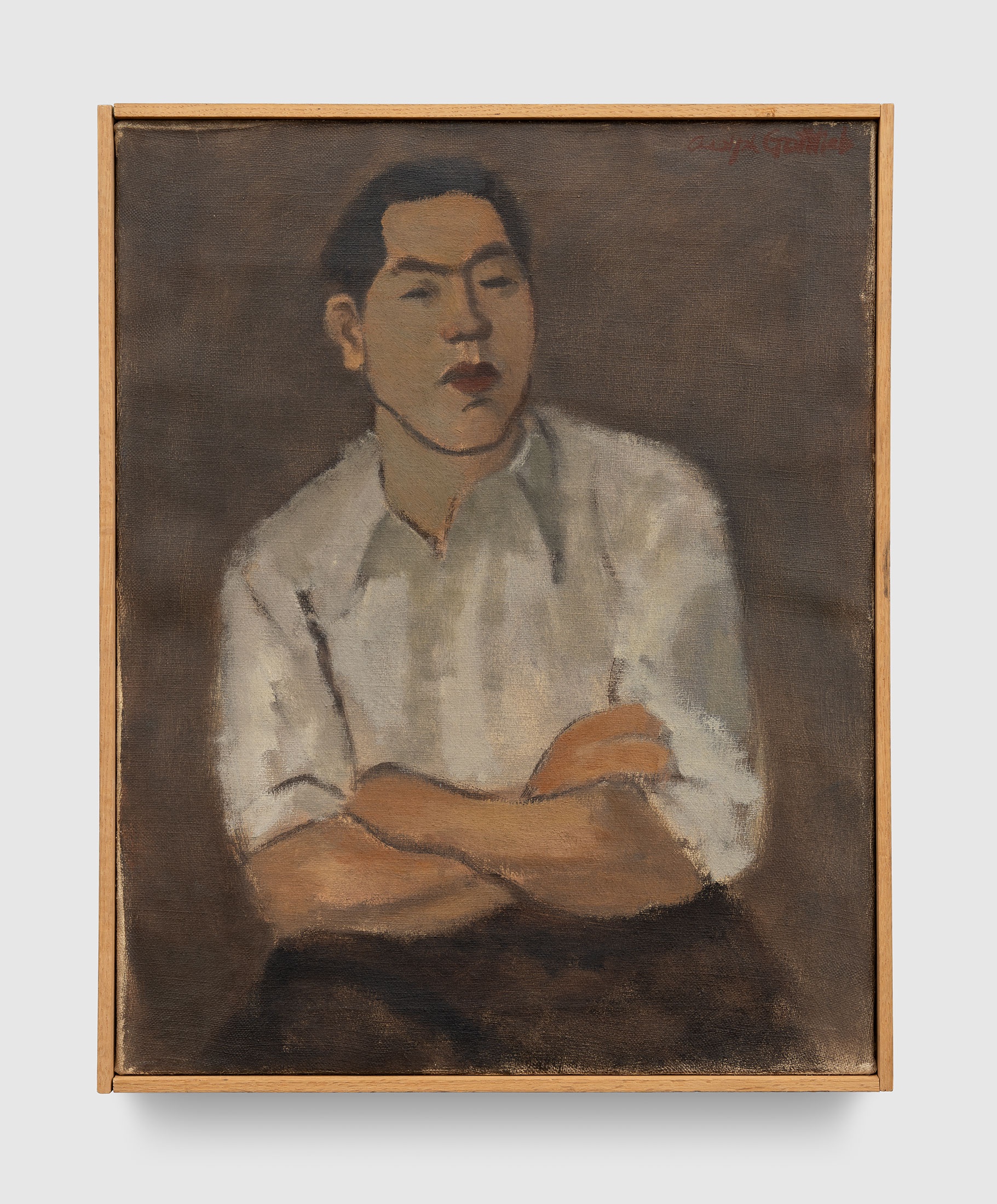
Both Adolph Gottlieb and his friend, the Japanese-American painter Thomas (Tomizo) Nagai, participated in the Works Progress Administration (WPA) Federal Art Project in the 1930s, a government patronage programme established during the Depression to support visual artists. The two belonged to the easel division, and their works were exhibited together at one of the WPA’s galleries in New York in 1936, a few years after this portrait was painted. None were for sale; all had been allocated to public institutions. By way of payment, the painters’ material costs were reimbursed. The Federal Art Project’s work-relief efforts supported artists regardless of talent or taste and, as a result, sponsored varied, often experimental projects, greatly influencing the production and reception of avant-garde art in the country. The WPA’s ambitions were laudable in this regard. Speaking that same year, the director Holger Cahill said: “The organisation of the Project has proceeded on the principle that it is not the solitary genius but a sound general movement which maintains art as a vital, functioning part of any cultural scheme. Art is not a matter of rare, occasional masterpieces.”
b.1903, New York; d.1974, New York
Though an influential exponent of Abstract Expressionism, Adolph Gottlieb was a painter of no single ideology. “Different times require different images,” he offered with aphoristic simplicity. Across his career, from the figurative expressionism of his early works to his Surrealist-inspired Pictographs and later Bursts, which compositionally unified Colour Field abstraction with its Action counterpart, the artist expressed a reluctance to settle into any one mode. His early life is further revealing of this essential restlessness: in 1921, at the age of 17 and with neither passport nor money, Gottlieb worked his passage to Europe, where he spent a year and a half visiting academies and museums. After returning to the United States, he became a founding member of both ‘The Ten’ in 1935 – a collective of avant-garde modernists – and ‘The New York Artist Painters’ in 1943, which notably included his friend and fellow artist Mark Rothko. The same year, Gottlieb and Rothko published a letter in The New York Times, now largely regarded as the first formal statement on Abstract Expressionism, and led a group of artists in protest at the Museum of Modern Art in New York in 1948, which earned them the epithet ‘The Irascibles’. The following decade, in 1953, Clement Greenberg curated the first survey of Gottlieb’s art, canonising the painter’s pre-eminent position in American modernism. As the critic wrote in a catalogue essay published three years later, “Gottlieb has done more than enough by now to assure his place in the art of our time… his continuing development provides, to a superior degree, that excitement of which art as an unfolding activity, not as a finished result, is alone capable.”