Caragh Thuring
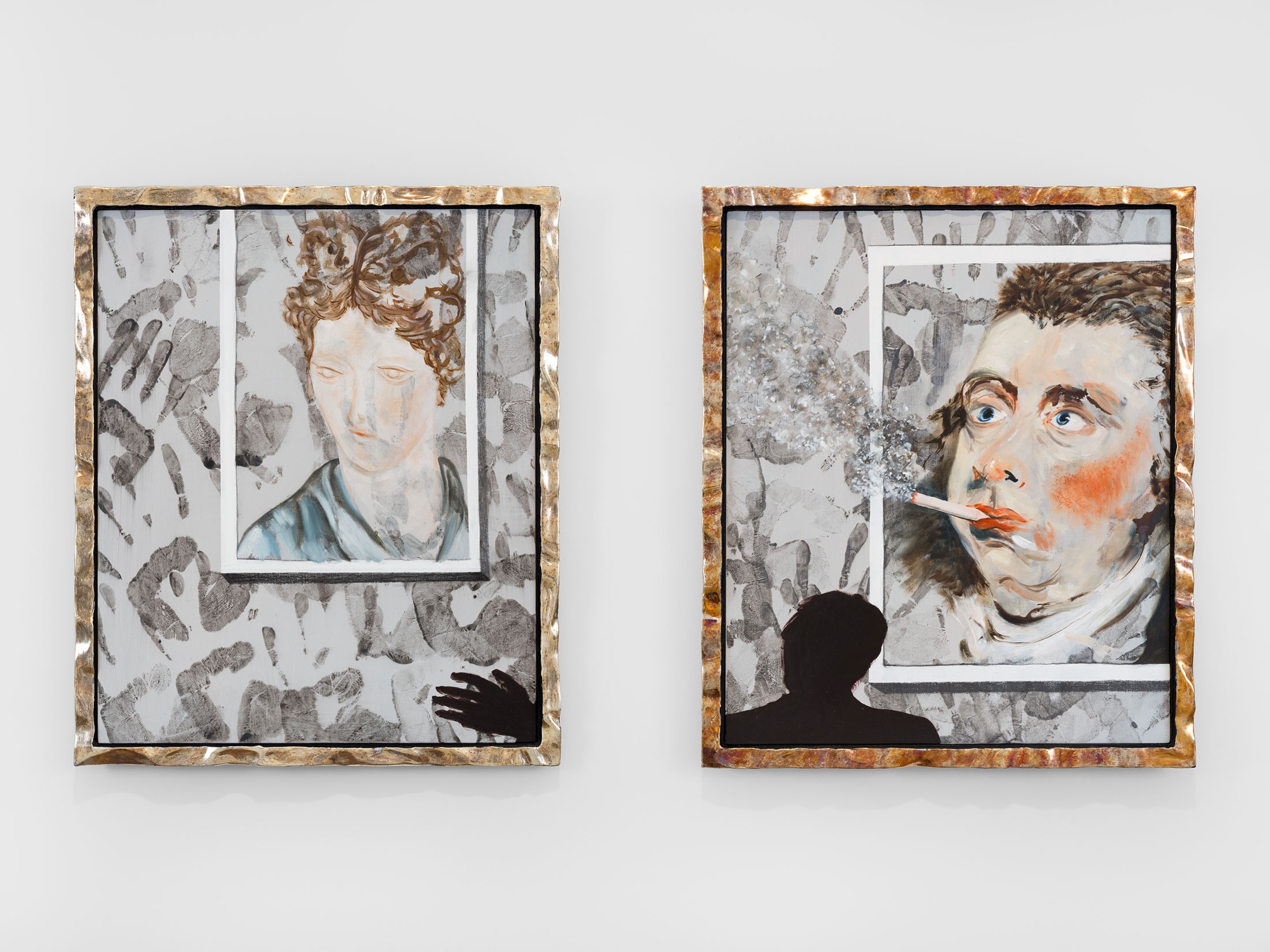
“I’m not interested in constructing readable vignettes within painting, but rather in how little traces of things might trigger interpretation… It’s an edit of the ‘real’, a distraction,” says Caragh Thuring. Comprising three figurative incidents – two busts framed within white borders and a silhouette that extends across the paired paintings – set against a textured background of inky handprints, this diptych at once suggests and undermines pictorial depth. A construction of parts rather than a representation of a scene, the relationship between the work’s features, while suggestive, is ultimately opaque. There is no apparent theme, no narrative to be parsed. Instead, these disparate things – ruddy-faced Rococo man, Regency-era Jane Austen-esque woman, shadowed figure cleaved in two – have been, as the title suggests, rescued from obscurity by the coincidence of their being arranged together, of their having found their way into this coupled composition. The diptych is finished in hand-carved silver-leaf frames.
b.1972, Brussels
In Caragh Thuring’s paintings, fragmented and oftentimes incongruous images are sparsely bricolaged onto a shared substrate (unprimed linen for the most part, but also tartan, board, sailcloth, and tapestries made from photographs of her earlier works). On these variable planes, art history coincides with dated advertisements and fashion magazine cut-outs, suburban impressions with those of industry and nature. Her collecting of such references – “fragments of facts” as she describes them, be they found or observed first-hand – follows no easily determined impulse. Together, she says, they become “an accumulative portrait of my environment; a strange summing up of everything that I’ve made, and a number of things that I’ve experienced, but I don’t want them to be taken as historical or nostalgic.” She continues: “I don’t want them to be wrapped up in memory... The works show something closer to an image of condensed time – a lateral portrait.”
In Thuring’s arrangements of seemingly unlike things, the activity of looking, the giving of time and attention, takes precedence over any compositional conclusion. While she never works from preparatory drawings, each painting is a sketch of a kind towards further iterations on the same theme. Revisiting figures and motifs across countless canvases, she asks how her chosen medium might frustrate one’s habits of looking. Painting, as Thuring suggests, “interrupts the speed of absorption”. Her pieces are an invitation to see differently, slowly, the immediacy of recognition purposefully delayed. One critic, writing on her work, described it as being “self-consciously decelerated”. Friction – between passages of pictorial coherence and abstraction, loosely described or densely detailed interludes – only emphasises this effect. As the title of a 2024 painting suggests, It Sticks It Judders It Jams.