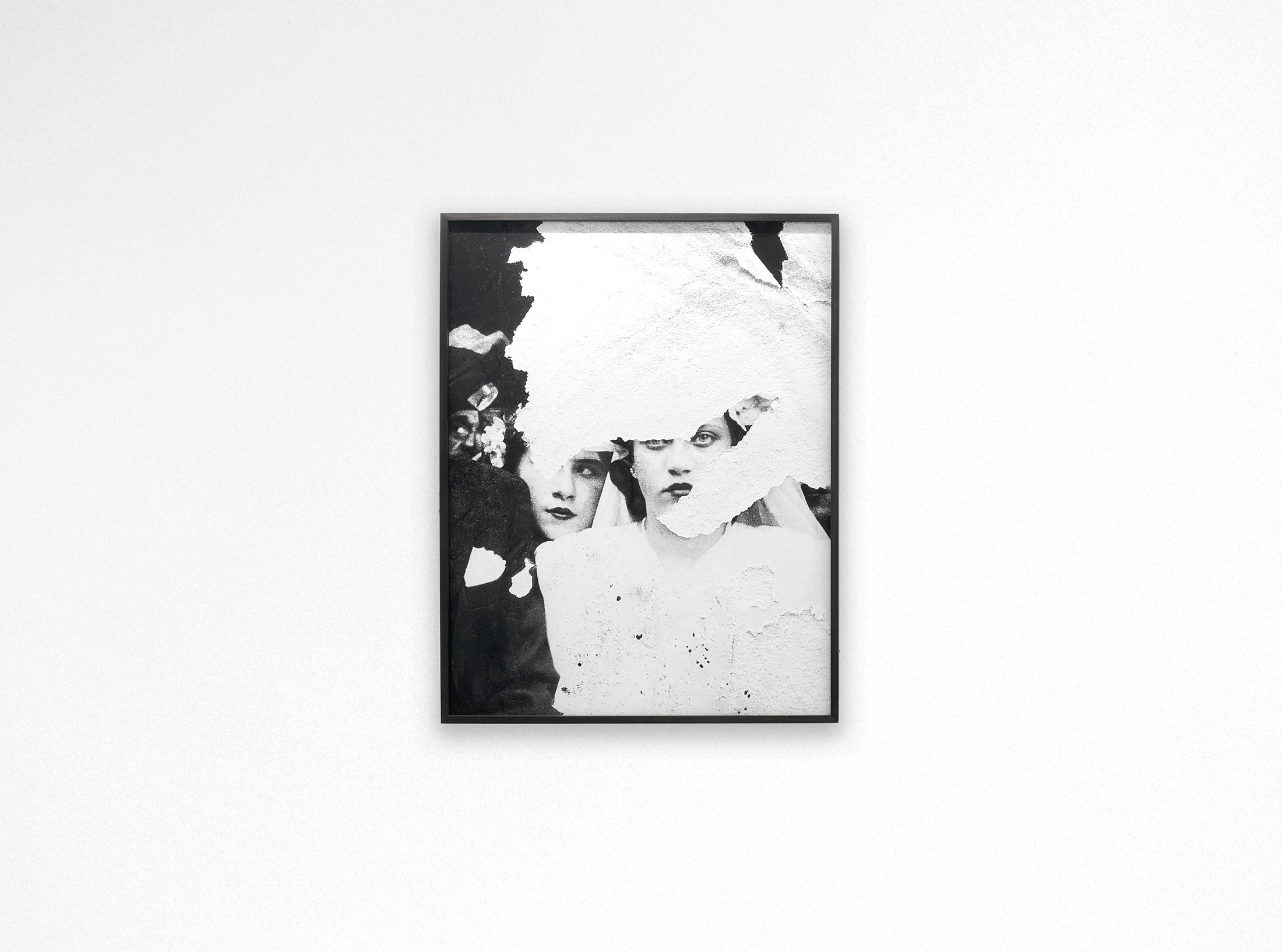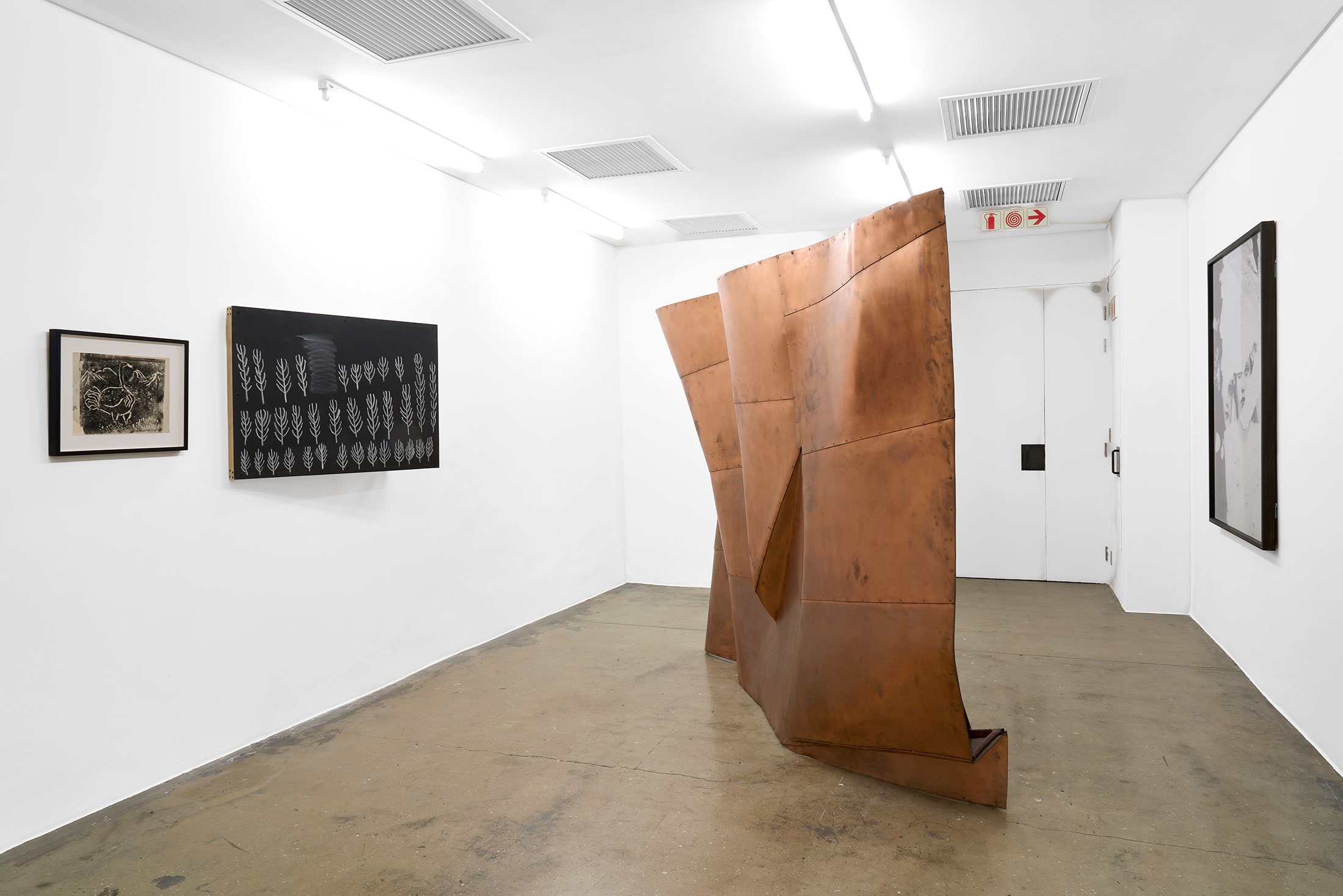
Begin with a backward glance. History addresses itself variously to the artist as artefact, material, subject, and story. In this first Sightline, three artworks offer three views into the past. In one, a found object is hung alongside a memory transcribed in chalk on blackboard. In another, a monument of conflicting resonance (safe harbour, war) stands as a fabricated fragment. In the last, a family photograph, reproduced at scale, magnifies both the individuals it describes and the damage that threatens to eclipse them.
How to picture the past? How to return to it a vivid immediacy, to lift the opacity of distance that has dulled its image?
The texture of time lost is particular to its traces: a recollection worn smooth by its retelling, a genealogy pockmarked by the missing, a story of origin weathered rough. Refigured as a medium, the past lends itself to both descriptive and speculative engagements, to factual retellings of what was and fictitious imaginings of what could have been otherwise. Such historical revisitations and reenactments as these might be differently conceived of as a restorative gesture, critical reappraisal, or “protest against forgetting.” They might be quietly revealing of personal stories or urgently provocative in the accounts they convey.
All three works gathered here extend from the biographical outwards, coming to rub up against the stuff of History – obliquely, evidently. Folded into their retrospective reflections are stories of individual and collective dispossession, ambitions deferred or flatly denied. So often recited as a series of triumphs, perhaps the past more properly belongs to the province of tragedy.
Included in this Sightline is Kemang Wa Lehulere’s Does this mirror have a memory 2 (2015), a found print by the late artist Gladys Mgudlandlu paired with a remembered impression drawn in conversation with the artist’s aunt, Sophia Lehulere; Danh Võ’s We the People (2011–2014), a 1:1 scale excerpt from the Statue of Liberty that returns abstraction to an abstract noun, and betrays the material lightness of the statue’s indelible form; and Dor Guez’s Samira (2020), a photograph of his grandmother on her wedding day in occupied Lydda in 1948, which extends reflections on indivisible histories, their proximities and palimpsests.