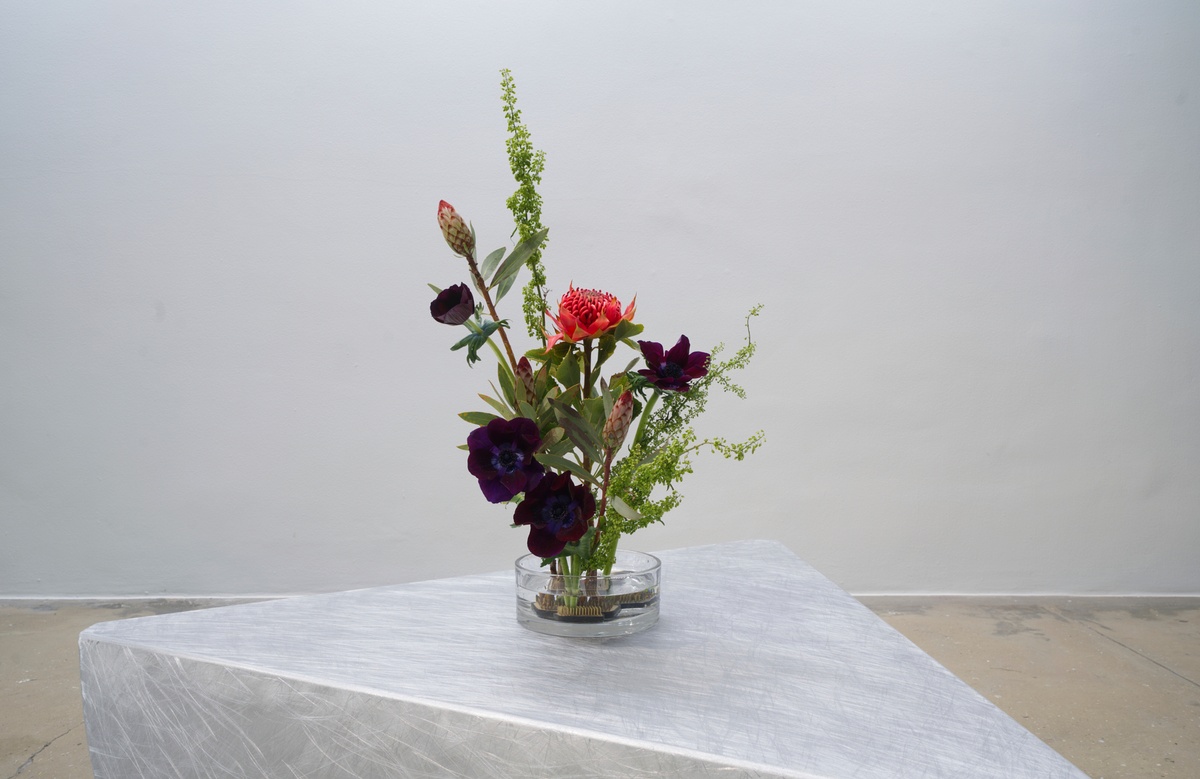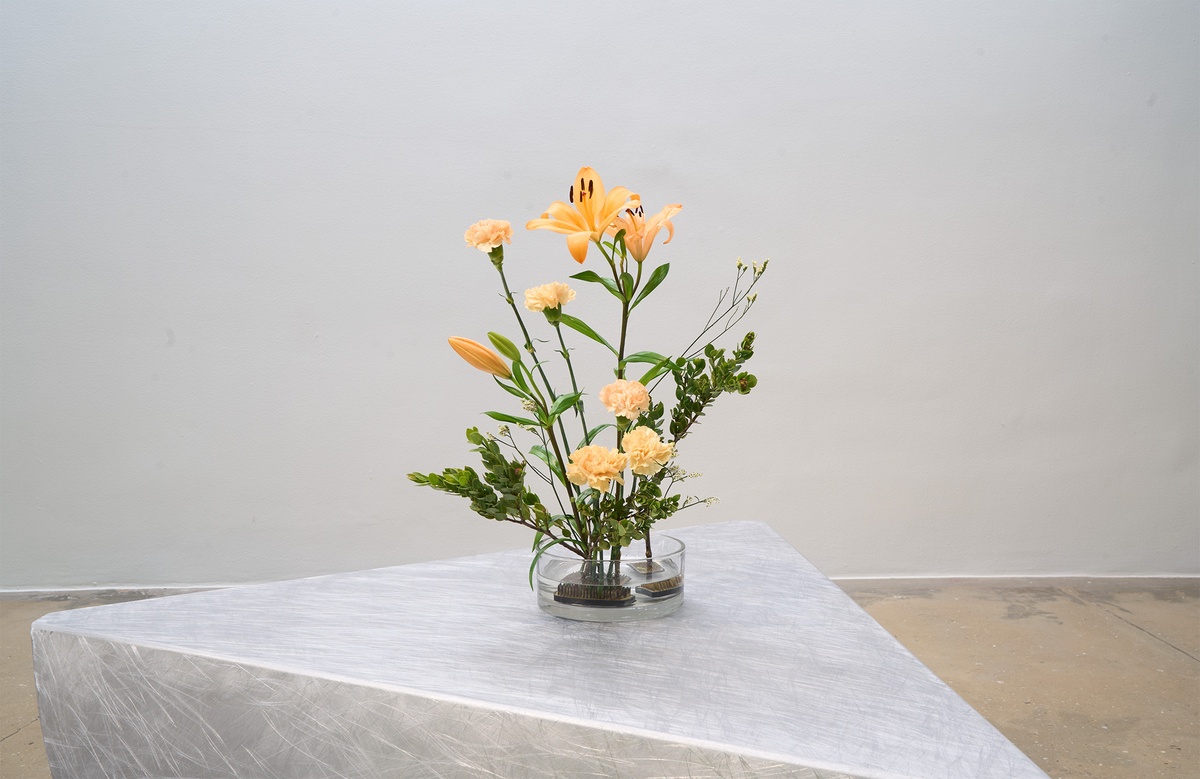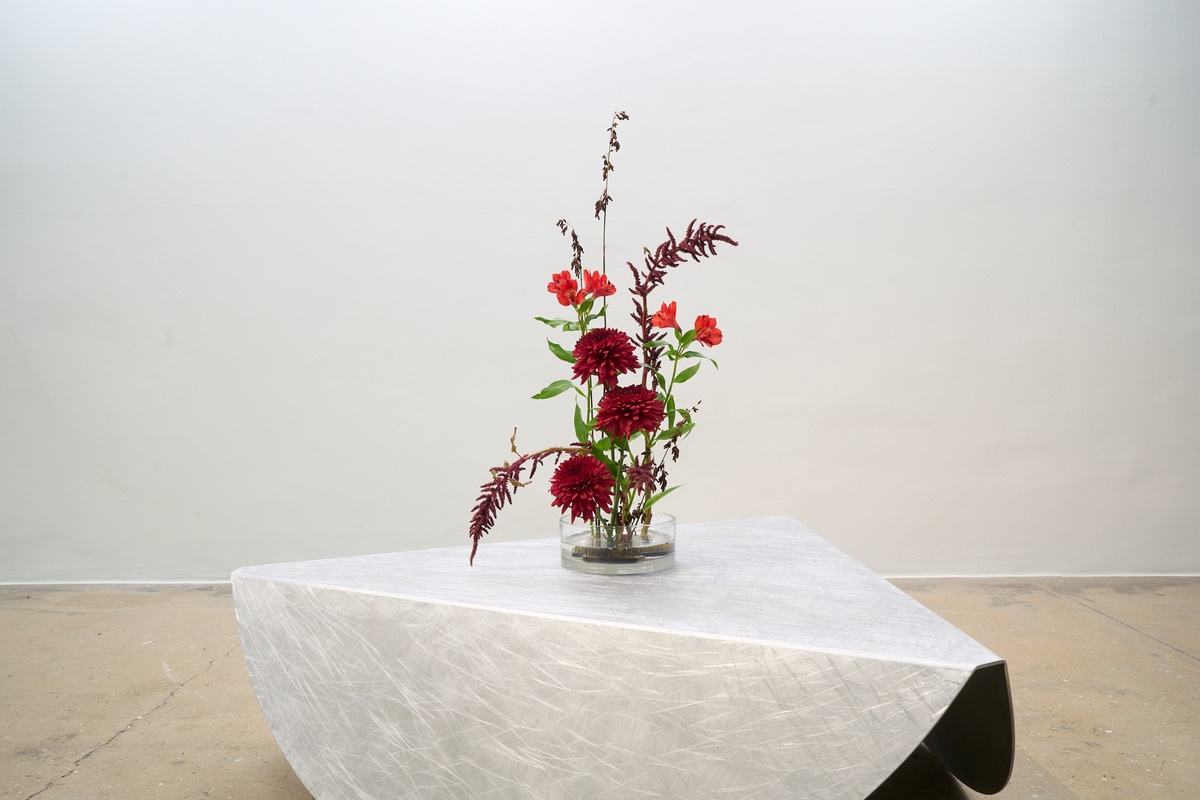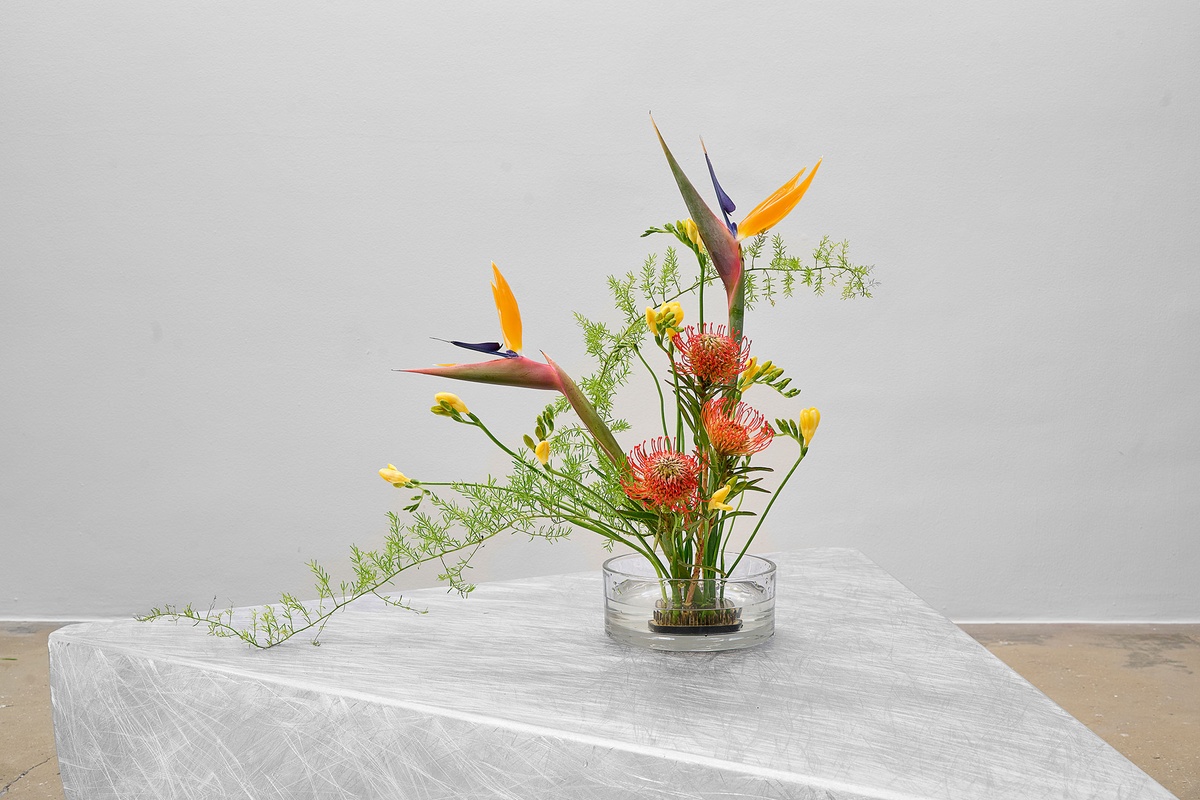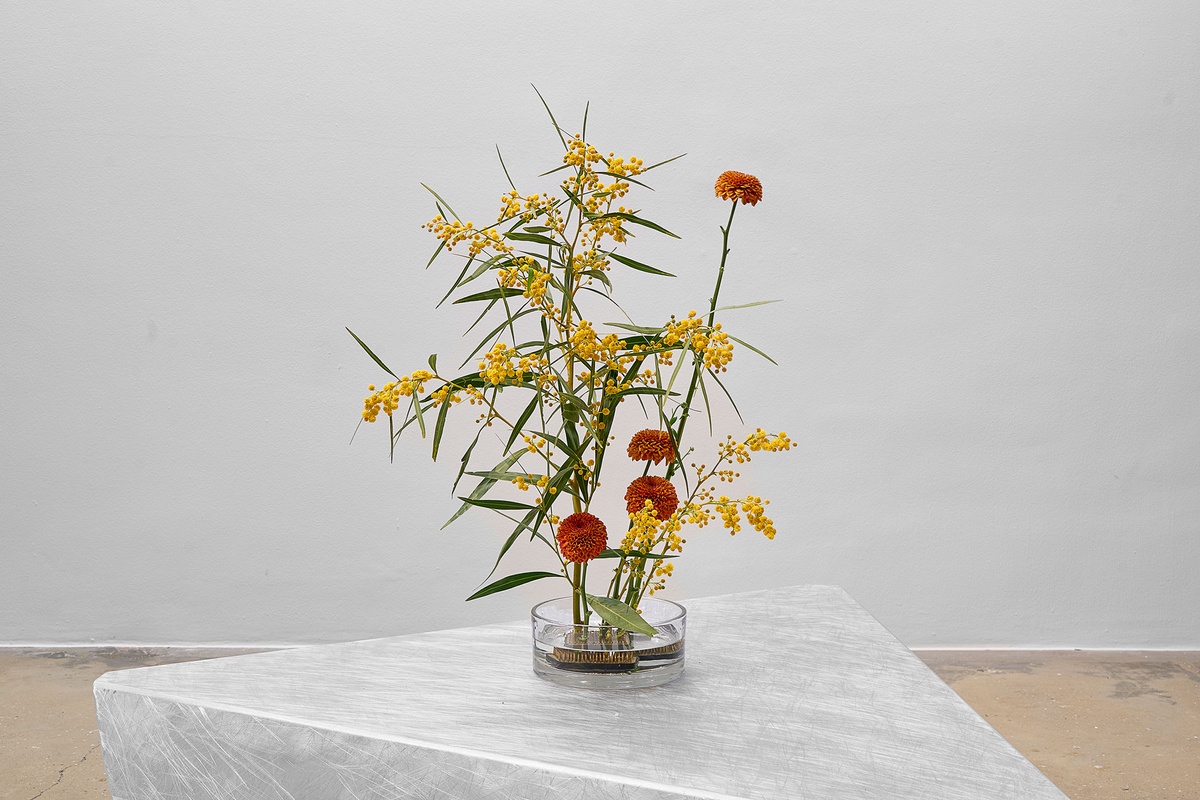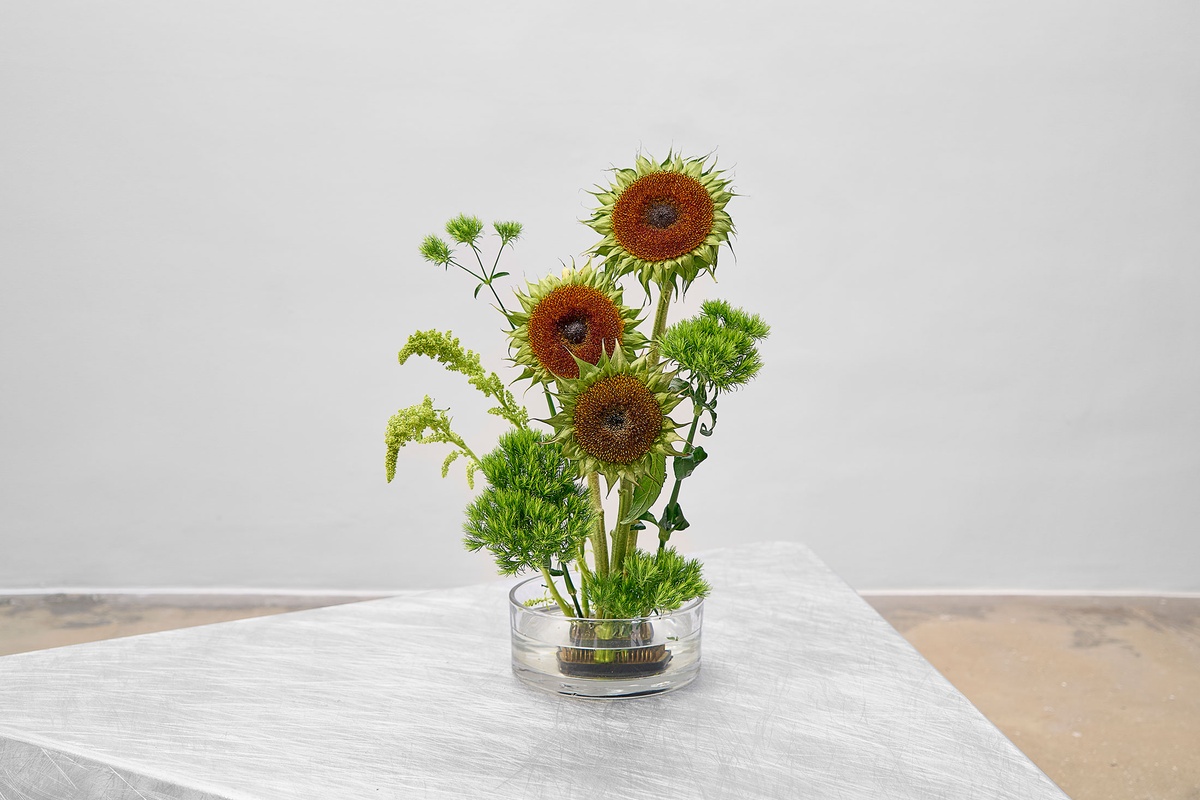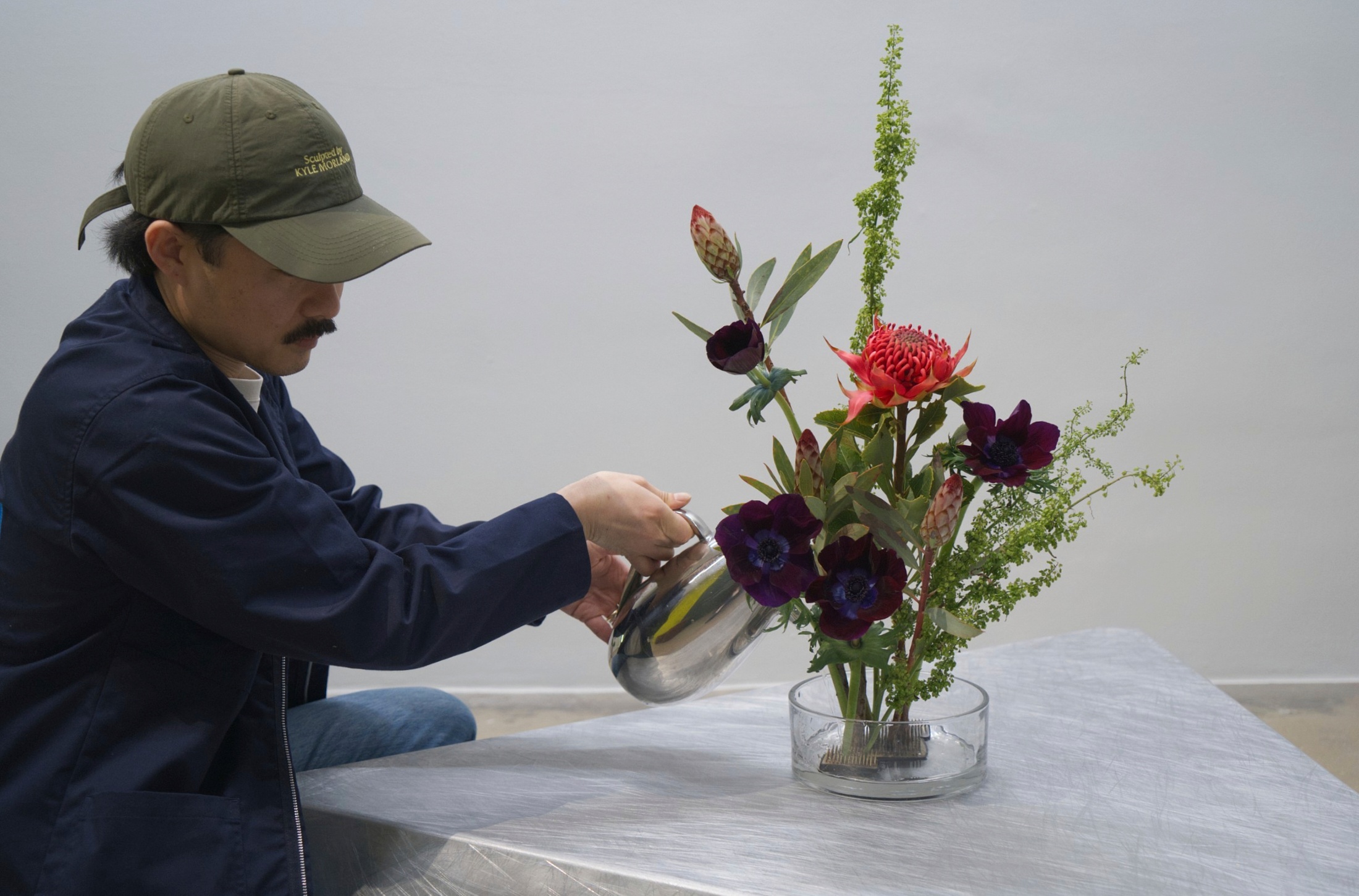
For the duration of the exhibition 1, 2, 3 – three concurrent, discrete projects presented under a shared title – A4 team member Taiyo Shimokawa composes a series of ikebana floral arrangements on the first-floor landing, set on Xandre Kriel’s three-sided Samosa table and accompanied by three low seats. As the entryway to the exhibition, alongside shelves of select publications and the wall text summarising the presentations on view, the flowers invite visitors to gather and read.
The sequence of arrangements made across the exhibition’s 14-week run highlights one of Shimokawa’s many contributions to our curatorial studio: he creates floral arrangements for our ground-floor bookstore and events. The rhythm of this practice begins with a weekly walk to the Adderley Street Flower Market, and follows a gardener’s attention to matters of pruning as the days pass. Flowers that wilt must be removed and any resulting absences balanced, every adjustment answered with a subtle intervention. Tending to these shifting compositions, Shimokawa tends to the visitor’s experience of our space.
In the context of 1, 2, 3, these considerations – of coherence, symmetry, proportion, even invitation – become something of a pivot around which the exhibition turns, an arrangement of voices drawn into relation, a different balancing of parts.
Located only minutes away from A4, the Adderley Street Flower Market is of historical and cultural significance to the City of Cape Town, and particularly to its coloured community. For over 150 years, generations of families have sold flowers at the site, set back from the street in a covered alley known as Trafalgar Place. Though many coloured residents were forcefully removed from the flower farms of Constantia under the Group Areas Act in the late 1960s and ’70s, the market itself persisted in spite of apartheid’s discriminatory policies, in large part due to the resistance of its vendors. As a result, it was one of the few commercial spaces in the city from which people of colour could operate with relative independence under segregationist policies. Recent efforts by the municipality to reclassify the flower sellers as informal traders, subject to limiting by-laws, are currently under contestation.
1, 2, 3 is curated by Lemeeze Davids, Khanya Mashabela, and Daniel Malan with Dada Khanyisa, respectively.