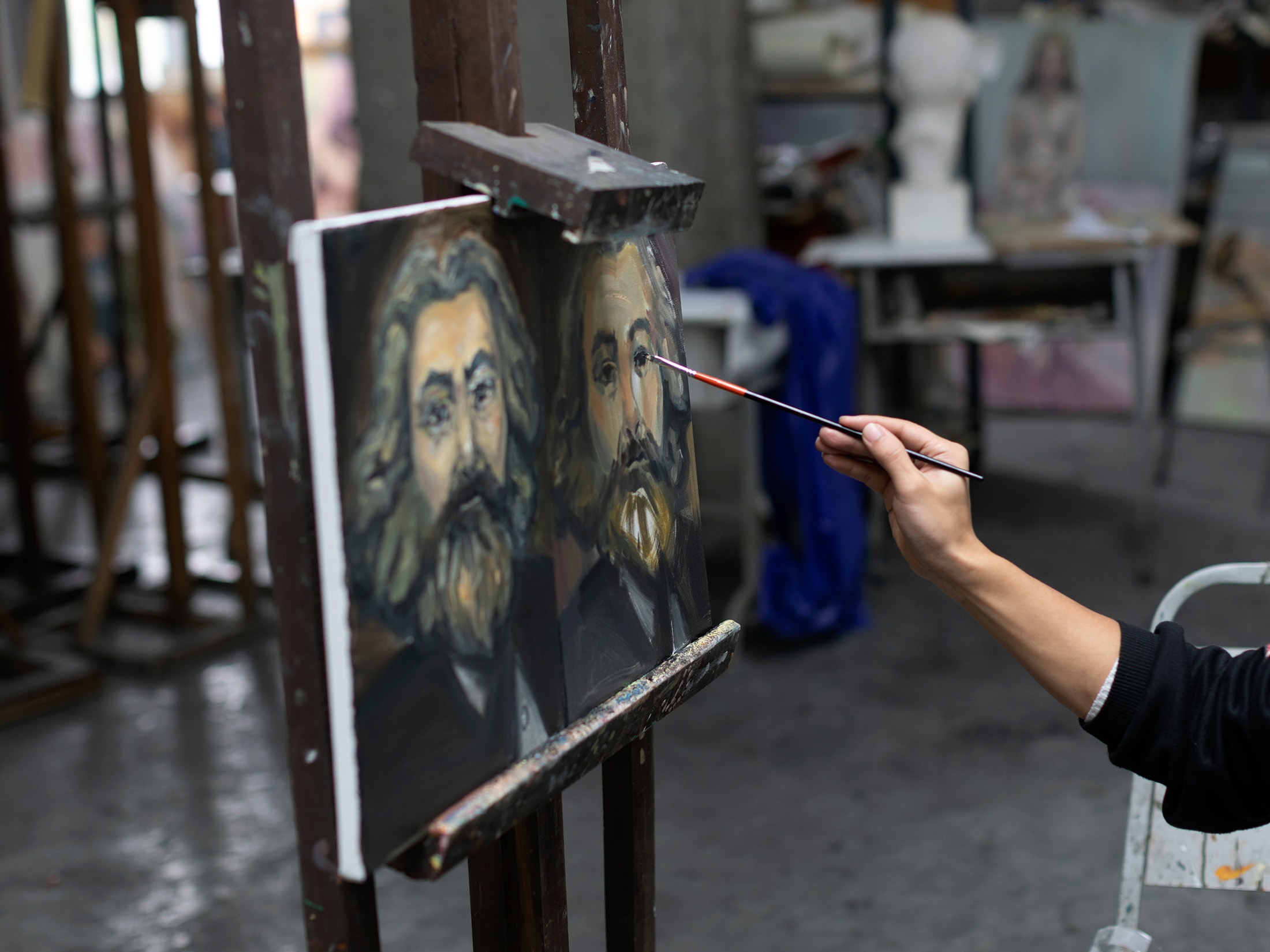
Patrick Waterhouse recommended that I read a passage in Francis Wheen’s biography of Das Kapital. Studying how the canonical book came to be, Wheen includes the angst of author Karl Marx. Marx worries how (even if) the book will be read. He has trouble keeping deadlines. Wheen shows us Marx’s anxiety by narrating some of the crucial action that takes place in The Unknown Masterpiece, a story by Honoré de Balzac (1831). Of this “little masterpiece”, Marx was particularly fond:
In February 1867, shortly before delivering the first volume of Das Kapital to the printers, Karl Marx urged Friedrich Engels to read The Unknown Masterpiece by Honoré de Balzac. The story was itself a little masterpiece, he said, “full of the most delightful irony”. We don’t know whether Engels heeded the advice. If he did, he would certainly have spotted the irony but might have been surprised that his old friend could take any delight in it. The Unknown Masterpiece is the tale of Frenhofer, a great painter who spends ten years working and reworking a portrait which will revolutionize art by providing “the most complete representation of reality”. When at last his fellow artists Poussin and Porbus are allowed to inspect the finished canvas, they are horrified to see a blizzard of random forms and colours piled one upon another in confusion. “Ah!” Frenhofer cries, misinterpreting their wide-eyed amazement. “You did not anticipate such perfection!” But then he overhears Poussin telling Porbus that eventually Frenhofer must discover the truth – the portrait has been overpainted so many times that nothing remains. “Nothing on my canvas!” exclaimed Frenhofer, glancing alternately at the two painters and his picture…1
Waterhouse’s The Unknown Masterpiece comprises a series of oil paintings – a collaboration between the artist and local painters from Chongqing, China, where he visited in 2019. With the help of a local translator, Waterhouse presented a painter with a painting of Karl Marx, inviting the painter to reproduce its likeness. He repeated this process, offering the same set of instructions to each new participant. No painter was shown any work but one – the painting directly preceding their own, and which they were asked to copy. At the end of this process, Waterhouse had 31 ‘replicas’ in hand: one for each year of Mao Zedong’s rule (1943–1976).
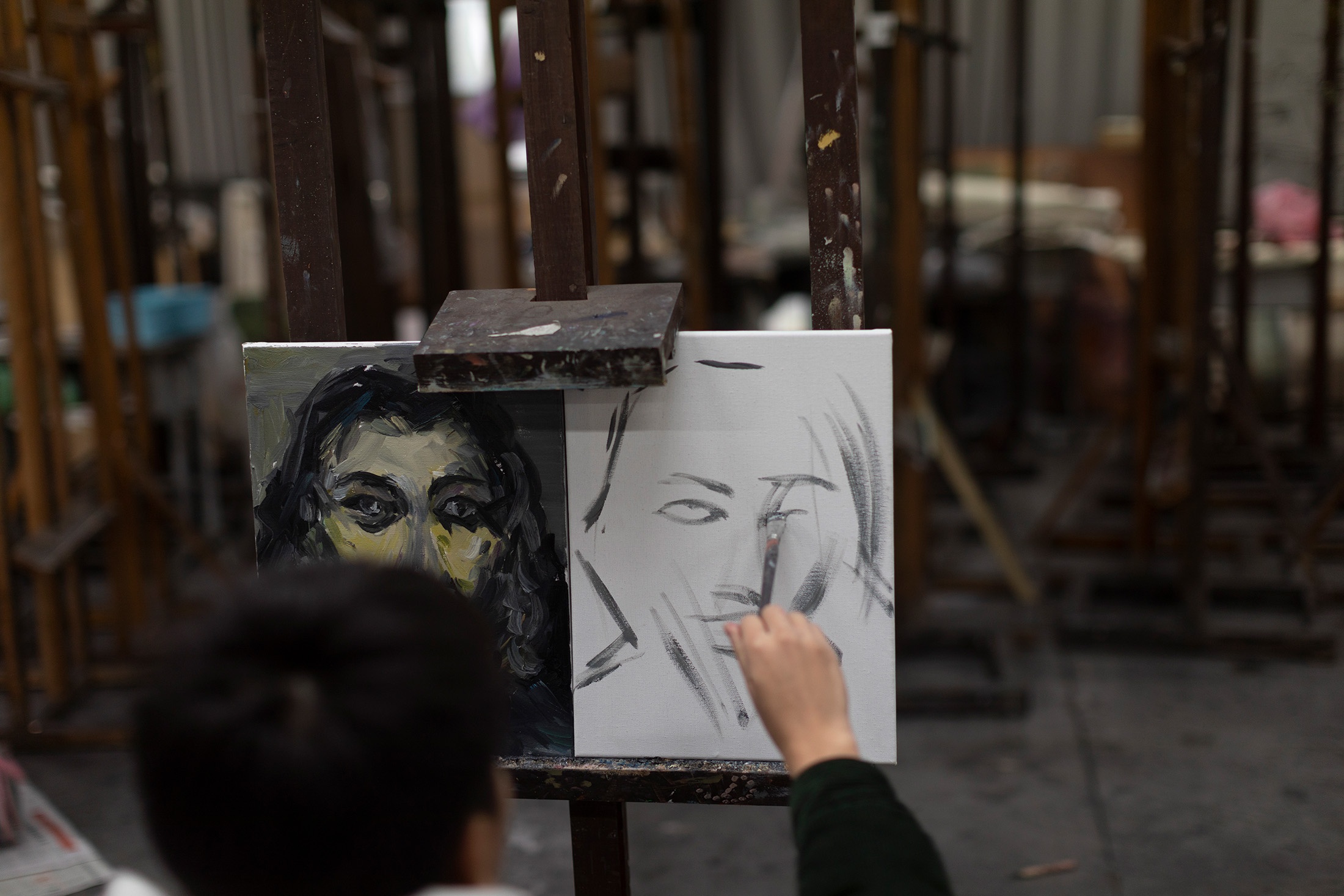
The outcome: that the lead protagonist becomes greener through repetition to stand unrecognisable at the finish line, was unscripted. At the time, Waterhouse wondered if the paintings would shift at all, expecting that the ‘copiers’ would create stable reproductions.
“Essentially, in people attempting to reproduce something as faithfully as possible, there are still slippages and innovations that happen within that process.”
Waterhouse applied Wheen’s title retrospectively, coming across the anecdote shared in the book at a later stage. This appropriation is uncannily fitting. The character Frenhofer in the story constantly paints and repaints his painting until, as Waterhouse says, “Balzac unknowingly describes an abstract painting.” Waterhouse is an artist skilled at bundling and burying references and intertexts into his practice. His work often explores intelligence as ‘dividual’, as shared, eschewing any positing of knowledge as the providence of one great mind, or belonging to a sole proprietor. I asked if he would explain his approach to theories of mind in a sentence, simply.
“What we think of as ‘intelligence’ is often much more of a social phenomena and plenty of what we attribute to individuals is in fact born of collective processes.”
Beneath the shifting image of The Unseen Masterpiece lies a sediment of ideas as pertinent now as when the project began: information deformed by time and interpretation, biased ideologies and manufactured conflicts that pit ‘West’ against ‘East’, racisms, fascisms, the phrase ‘Made in China’ and its interpretations, the impact of trade agreements, policies of exclusion, neoliberalism, protection, capitalisms, communisms, to name a few. (That Waterhouse found himself in China when the borders quite suddenly began to close due to Covid, offers further grit.) He offers: “How do you put thoughts into images in a way that helps people know that thoughts are ideologies? This can be done through putting unlike things together that shows their likeness, it can be done through subversion, or intervention. You need categorisation, but it’s also the start of all the problems, the differences… We need category to understand the world, but category can lead to tyranny.”2
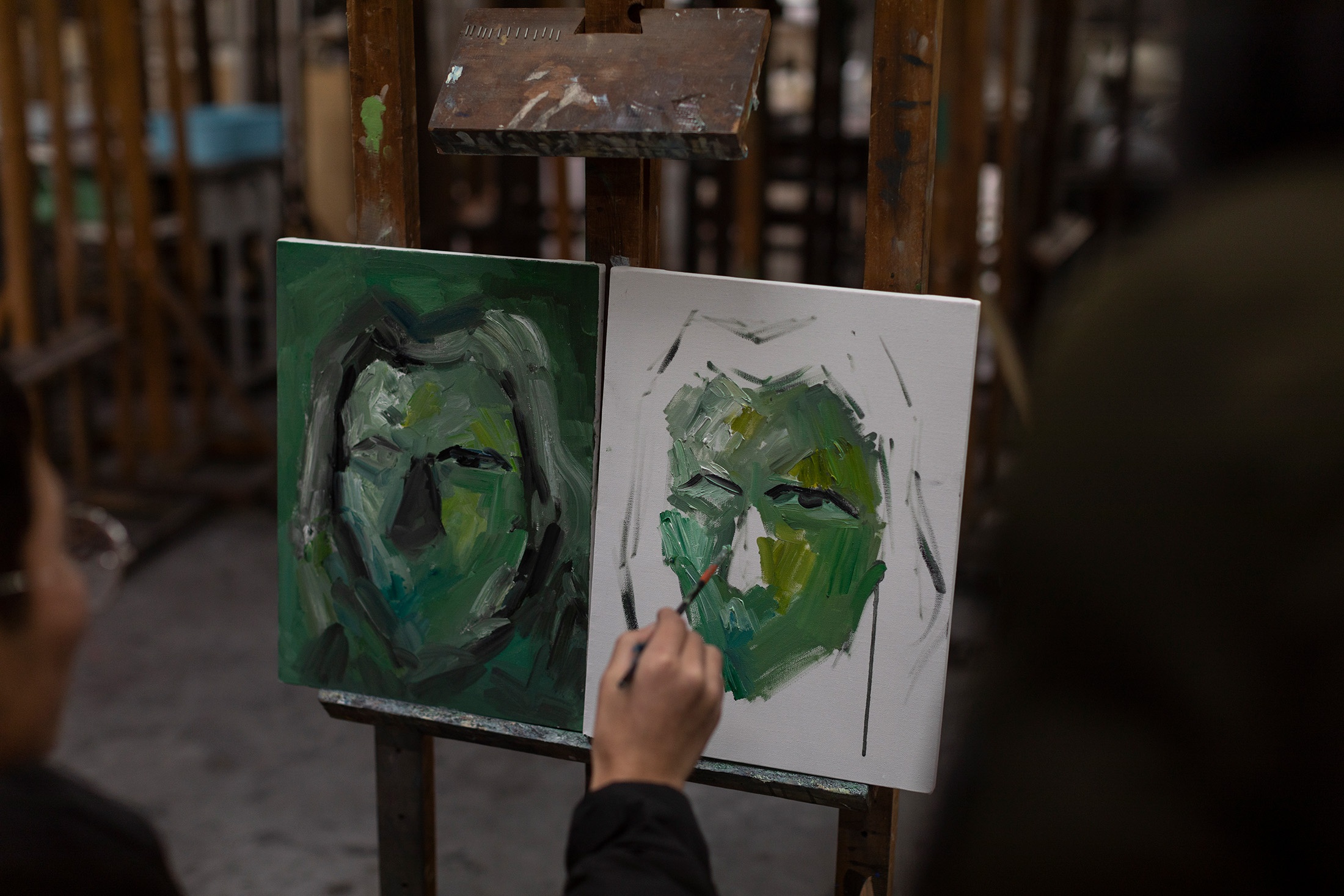
The Unseen Masterpiece is reimagined in book format for publication as the third in a series of artist zines published by A4 Arts Foundation. Ten special editions of the zine include a lenticular print in wood documenting the first and last images of ‘Jesus’ captured in a similar ‘broken telephone’ painting exercise to the one described above.